
Order Management System
From first conversation to final invoice — one connected workflow across every channel.
Integrated, end-to-end modules for CRM, Deals Manager, Campaign Manager, Billing & Reporting. Works as a fully integrated solution for broadcast radio — connecting natively to adserve Pulse — and extends the same commercial journey seamlessly to digital audio, video, social and online channels.
One connected workflow.
From first lead to invoiced revenue — every step runs through one system, with no re-keying between modules.
Client intelligence
Generic CRMs do not understand media. They treat an agency, a brand and a buying point as three unrelated records, force commercial teams to maintain "the real picture" in spreadsheets on the side, and leave revenue, pipeline and campaign history scattered across three systems that never agree at month-end.
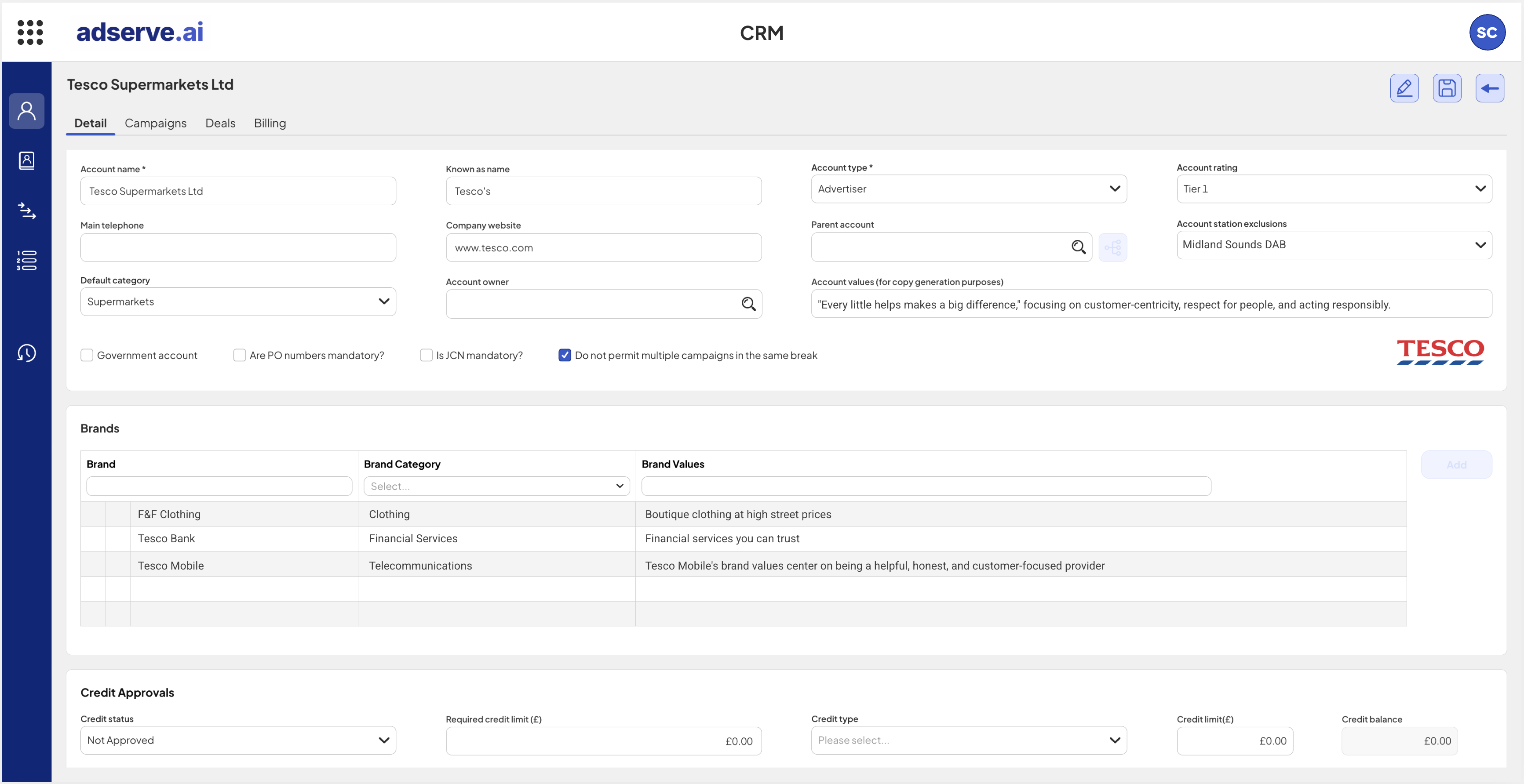
adserve's CRM is built around the actual structure of the commercial relationship — agencies, advertisers, brands, buying points and their parent groups — with every interaction, proposal, confirmed booking and invoice linking back to one client record. Pipeline, share-of-wallet, run-rate, contract status and credit position sit in the same view, derived live from the platform itself rather than reconciled from elsewhere. And where a client already runs an enterprise CRM, adserve's CRM shares data with systems such as Salesforce, Microsoft Dynamics and HubSpot — so the media-specific record stays in sync with the wider business.
The screenshot shows a single agency view: hierarchy on one side, live revenue and campaign activity on the other — the kind of single source of truth digital-first platforms quietly assume their clients already have somewhere else.
Commercial complexity handled
Broadcast pricing is not a spreadsheet — it is rate cards stratified by station tier, daypart and audience, layered with seasonality, value pots, agency commissions, negotiated overrides and dynamic pricing rules that move with sellout. Most platforms force commercial teams to encode that complexity in PDFs and tribal knowledge. adserve treats it as data.
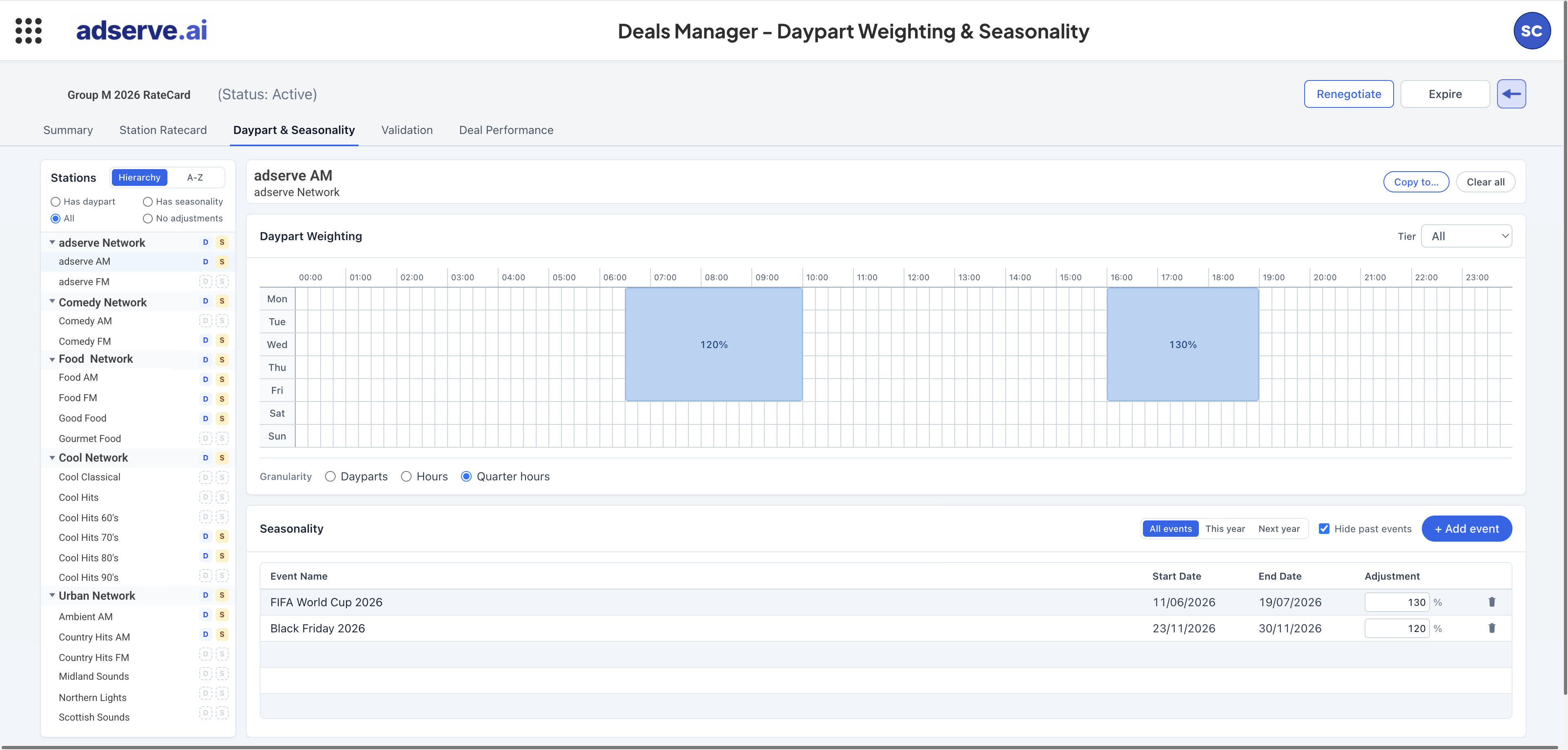
Deals Manager models every dimension of pricing as a versioned, governed object — rate cards, daypart weightings, partner/competitor station treatments, dynamic rules, agency-specific deals. The AI layer flexes prices within those rules as demand moves, so revenue teams release a yield curve instead of defending a static card; the audit trail keeps finance and compliance comfortable that pricing didn't drift outside policy.
Pre-built and custom multi-channel packages let sales reps quote linear, digital audio, video, social and online inventory in one proposal — at the omnichannel level, not stitched together across systems after the fact.
Plan, book, deliver
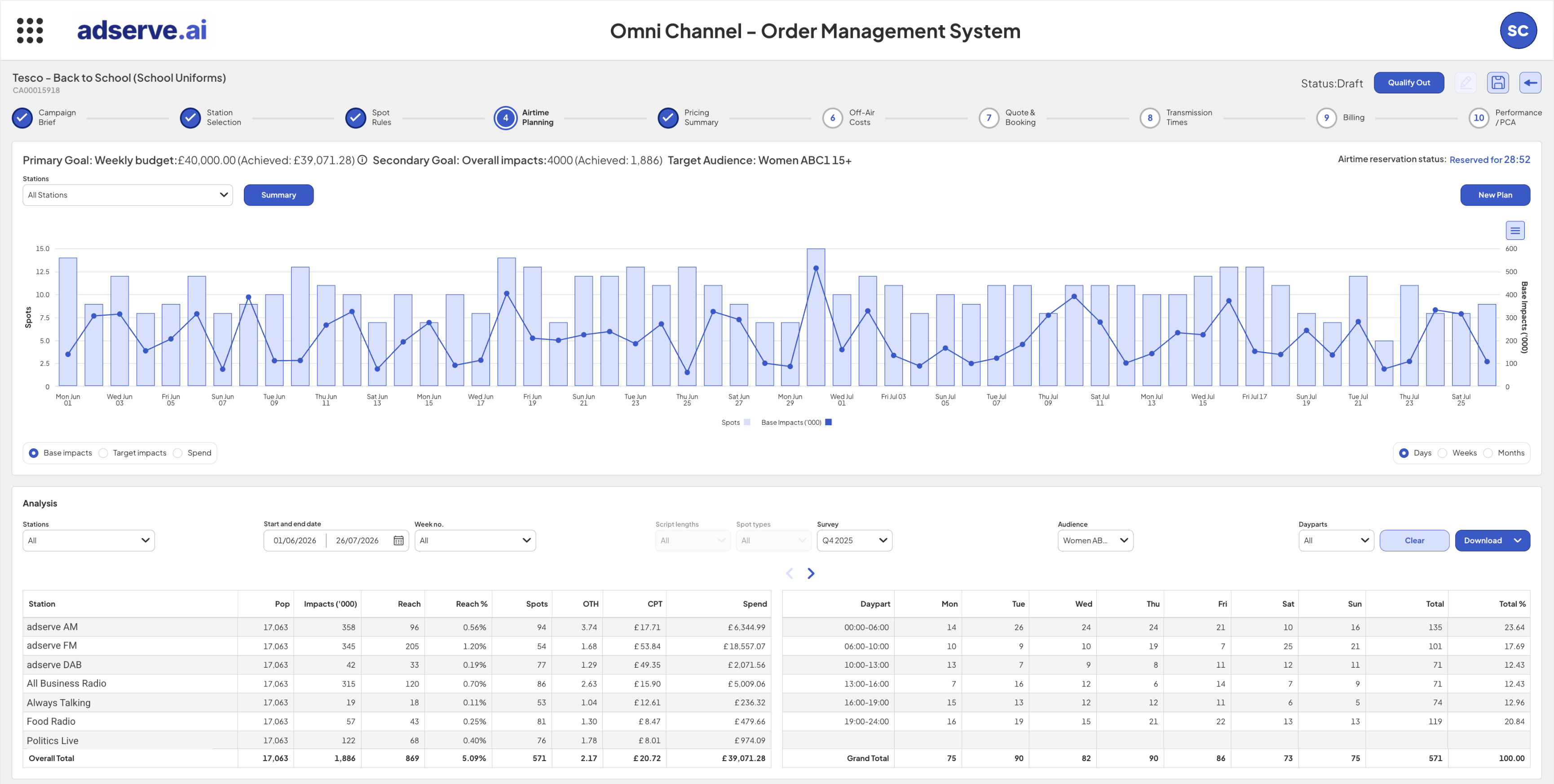
In most station groups, building a media plan is still a multi-day, multi-spreadsheet exercise — and the moment a brief changes, the work starts again. Campaign Manager closes that gap with an AI planning engine that turns a brief into an optimised, audience-led, fully allocated plan in around 25 seconds, against live inventory in Pulse and live audience data from RAJAR, JNLR, Ipsos and third-party measurement.
The planner stays in control: every output of the AI is editable, every constraint is visible, and the daypart and day-of-week weightings can be tuned without rebuilding the plan from scratch. The same brief can mix broadcast radio, digital audio, video, social and online — one objective, one optimisation, one omnichannel plan.
When the advertiser approves, the proposal becomes a confirmed booking without re-keying, and flows downstream into Pulse for scheduling, into Trafficking for delivery, and into Copy & Creative for AI-generated scripts. One workflow, end to end.
Revenue closed
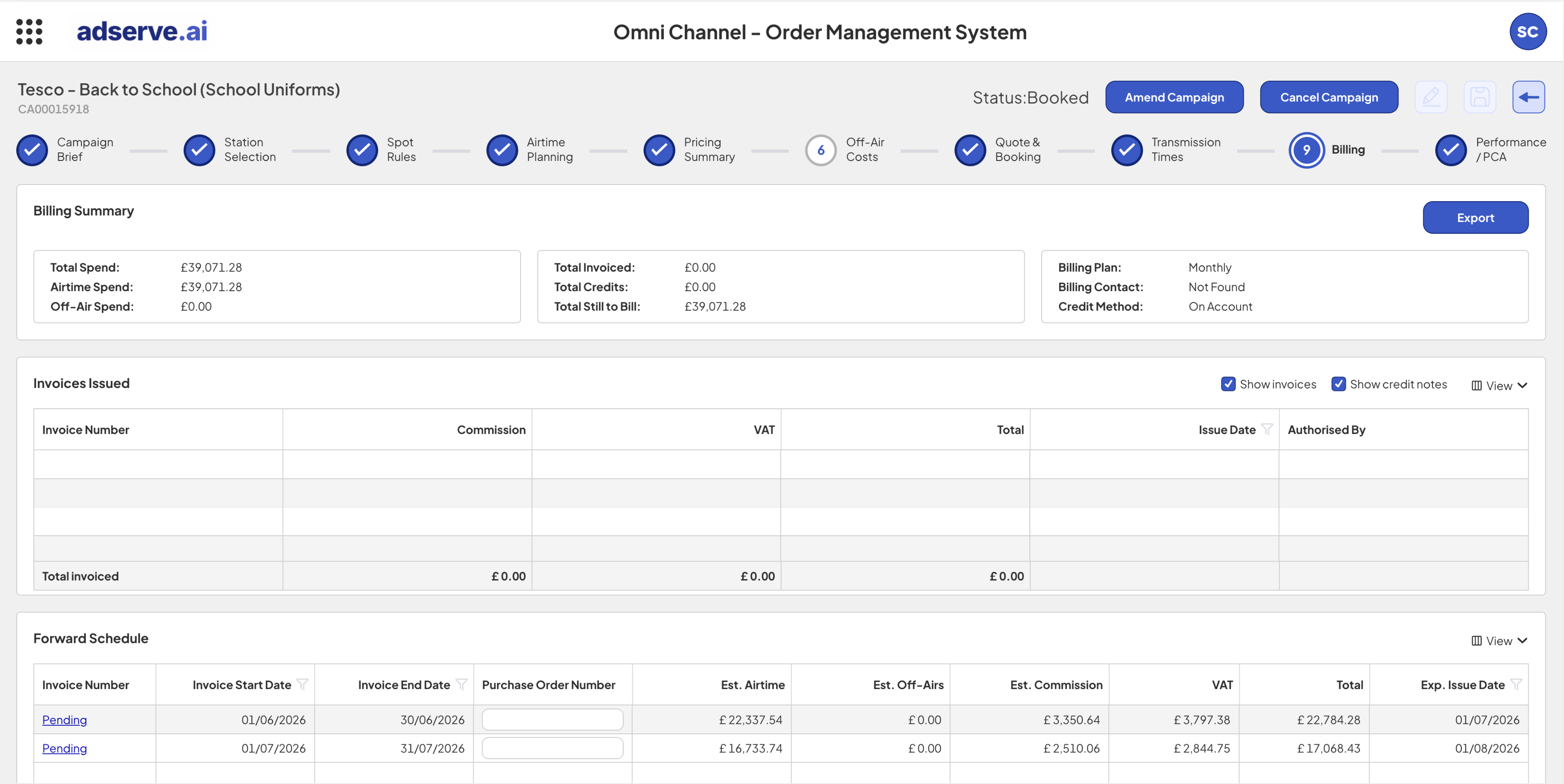
Most broadcasters bill from the schedule and reconcile with playout afterwards — a process that leaks revenue every month through unverified airplay, unpicked-up makegoods and quiet timing mismatches between systems. adserve inverts this: only confirmed broadcasts generate invoices, because Pulse's reconciliation feeds billing directly. What aired is what's billed, and the audit trail goes all the way back to the original brief.
AI-driven revenue modelling forecasts in real time against pacing, pipeline and historic seasonality — giving commercial leadership a forward view that's actually trustworthy, not a snapshot a week behind. Credit management, dunning, agency commissions and SOX-grade controls are first-class concerns, not bolt-ons. Integrations into SAP, Salesforce, Microsoft Dynamics and QuickBooks keep finance teams using the systems they already trust while adserve does the heavy lifting upstream.
Inside Deals Manager & Campaign Manager.
Below the surface of the four-step journey, these are the operational tools that sales, planning and revenue teams reach for every day.
Deals Manager
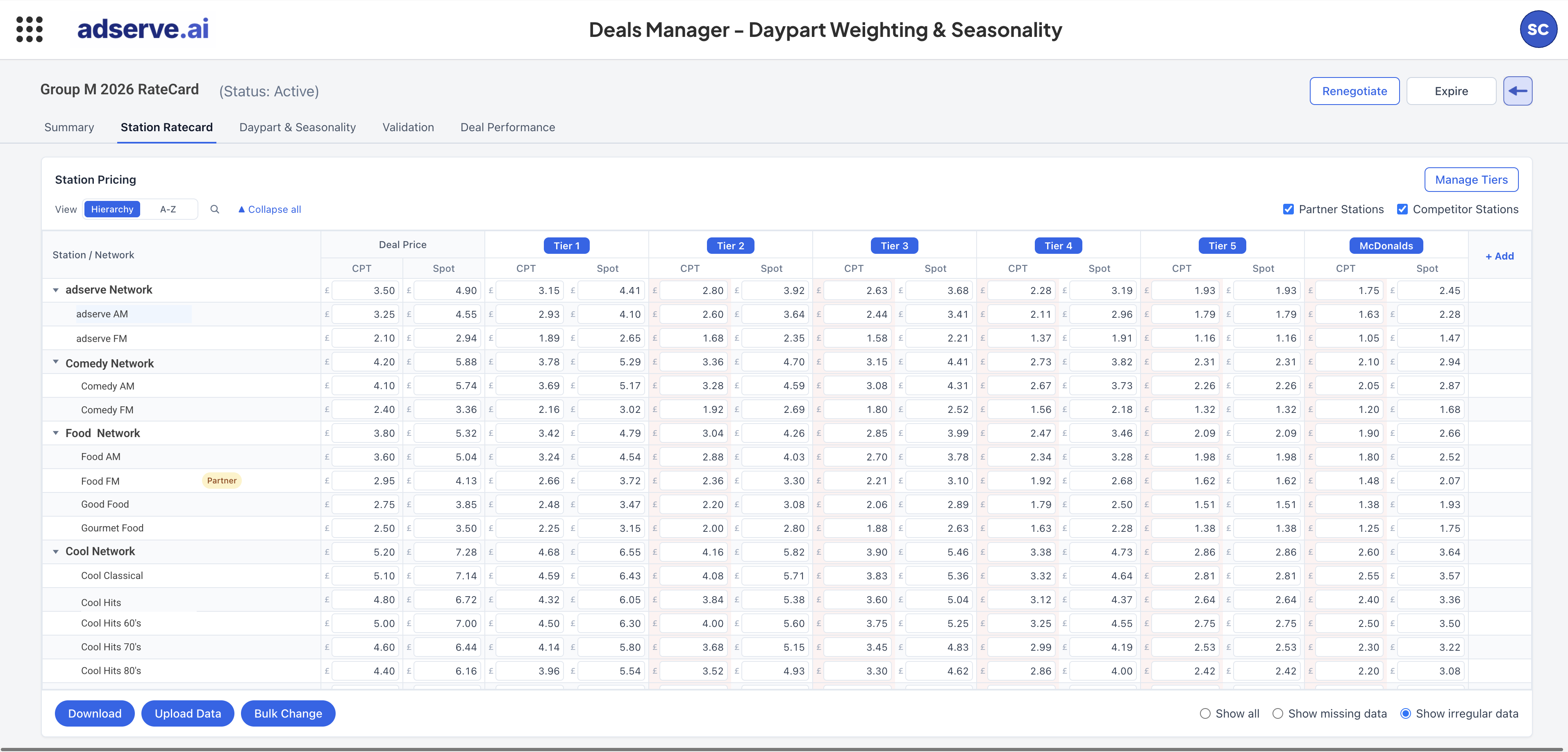
Rate card management
Rate cards are the backbone of broadcast pricing — and where most platforms trap teams in PDFs and tribal-knowledge overrides. adserve treats them as live, governed data.
- Configured by agency, station tier and daypart — with partner/competitor overrides, seasonality and audience adjustments as native dimensions
- Every change versioned: historical pricing recoverable, auditable and defensible
- One structure powers dynamic pricing, AI yield optimisation and live forecasting — no separate copies
Dynamic pricing rules
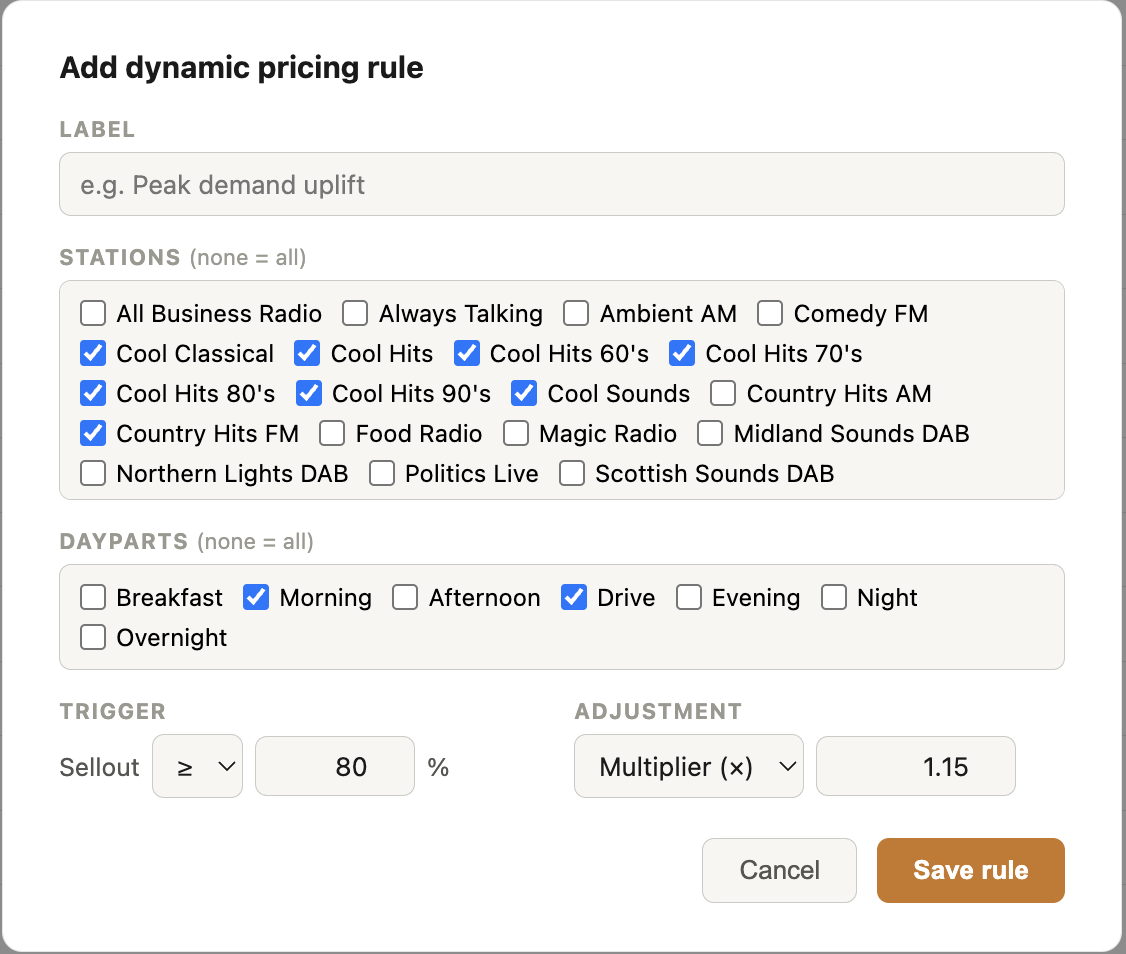
Static rate cards in a dynamic market are why linear inventory is so often under-monetised. Dynamic rules encode the yield logic teams never had time to run by hand.
- Drive sellout in Cool Hits crosses 80% → rates rise; Breakfast lead time under a week → prices ease to clear
- Triggers and adjustments expressed as data — stations, dayparts, conditions, multiplier, floor and ceiling
- Pulse evaluates continuously against live demand; the team supervises, the audit trail stays intact
Campaign Manager
S&P Property Designer
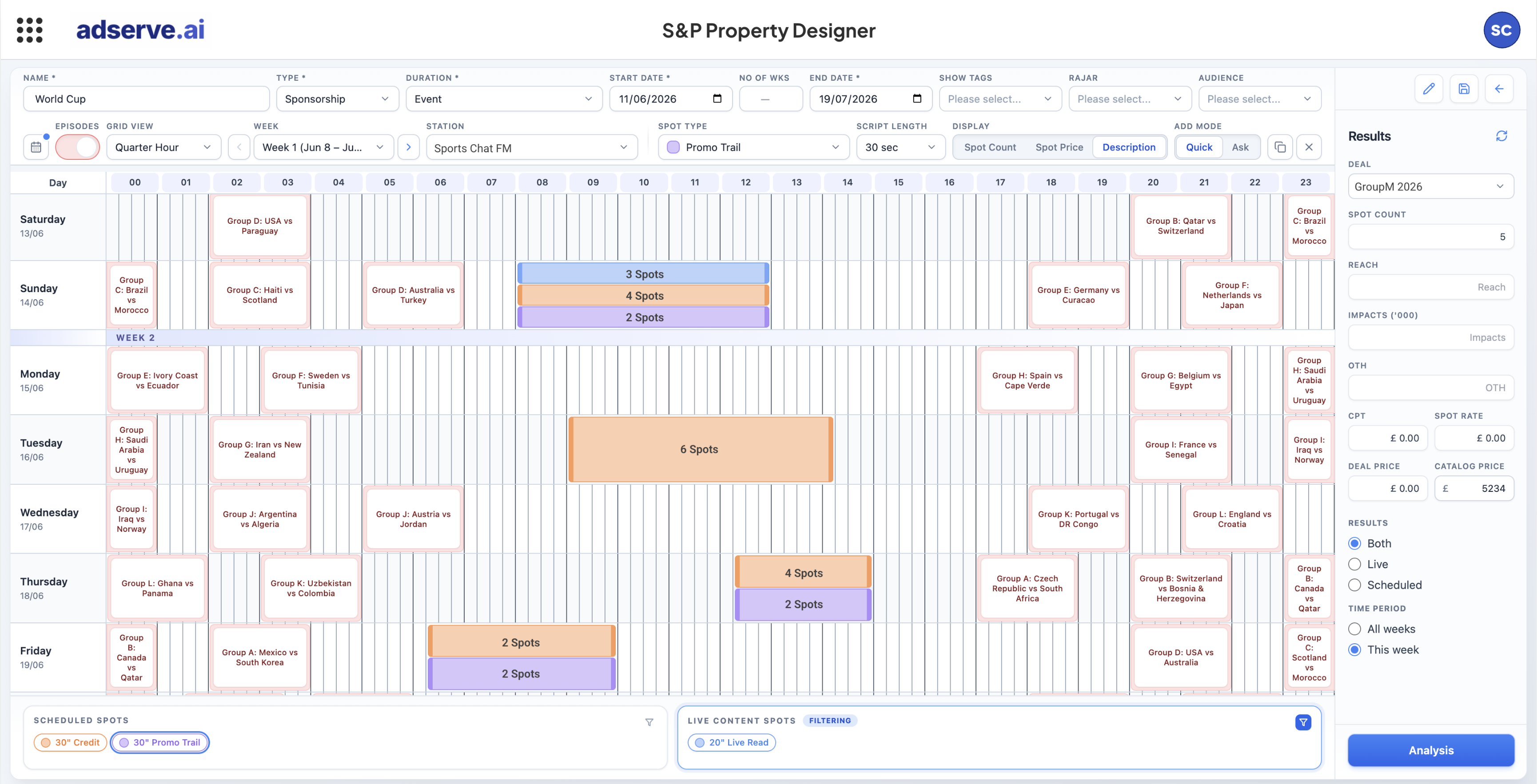
Your most lucrative inventory — sponsorships and roadblocks — and the easiest to under-price when it lives in PowerPoint.
- Designed visually on a day × time grid, over the live break composition
- Stack sponsor packages, lock breaks, see real impacts before you sell
- Goes to market as real inventory — not a slide trafficking has to honour later
Planning summary
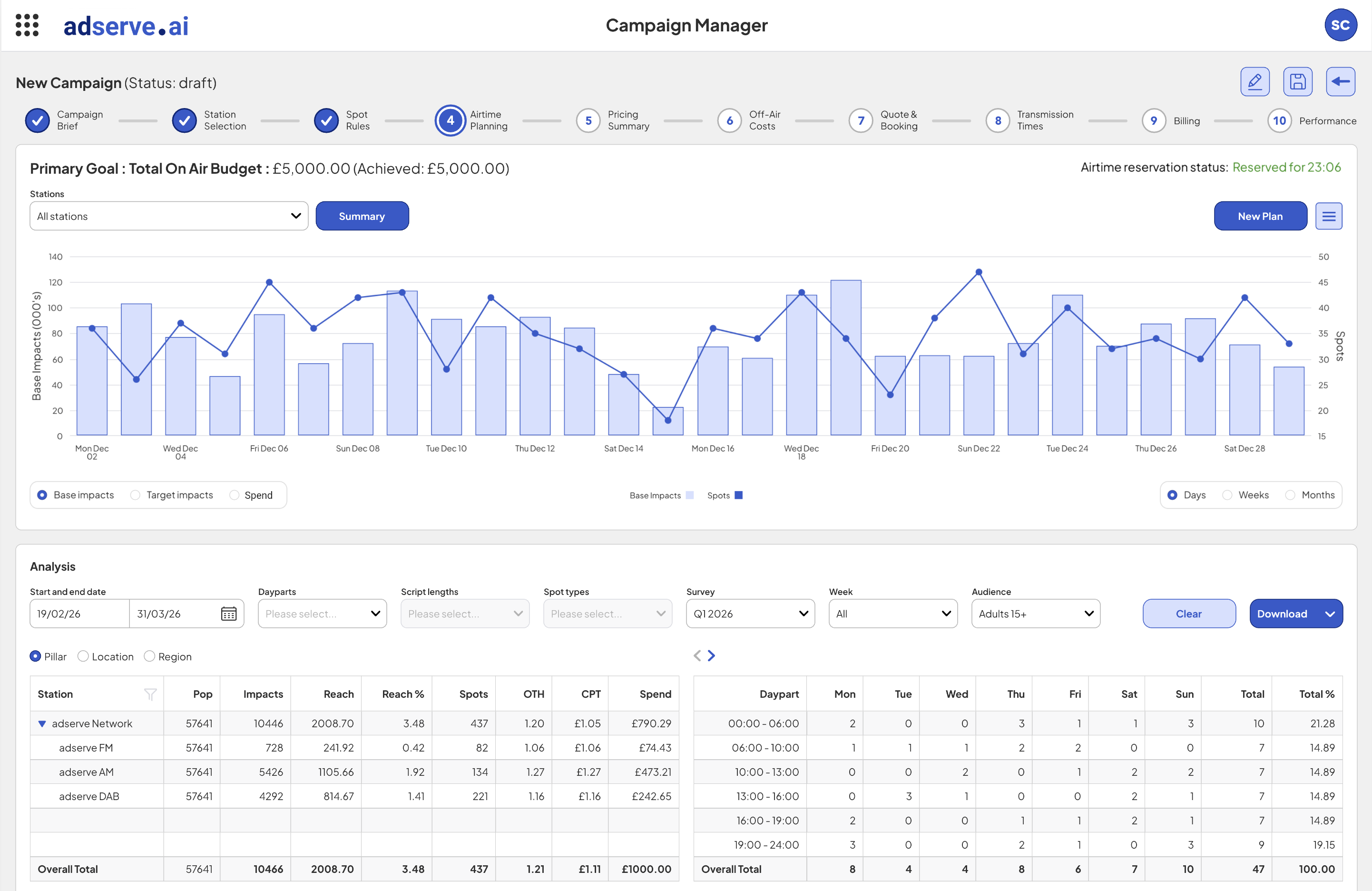
Where an AI-generated plan becomes a decision you'll put in front of an advertiser — live and editable.
- Goal vs achieved: on-air budget against airtime cost, impacts, station reach, CPT and daypart split
- Every assumption exposed — retarget, reweight a daypart, exclude a station, change budget
- Re-optimises against the same goal in seconds. AI does the maths; the human judges
Planning rule adjustments
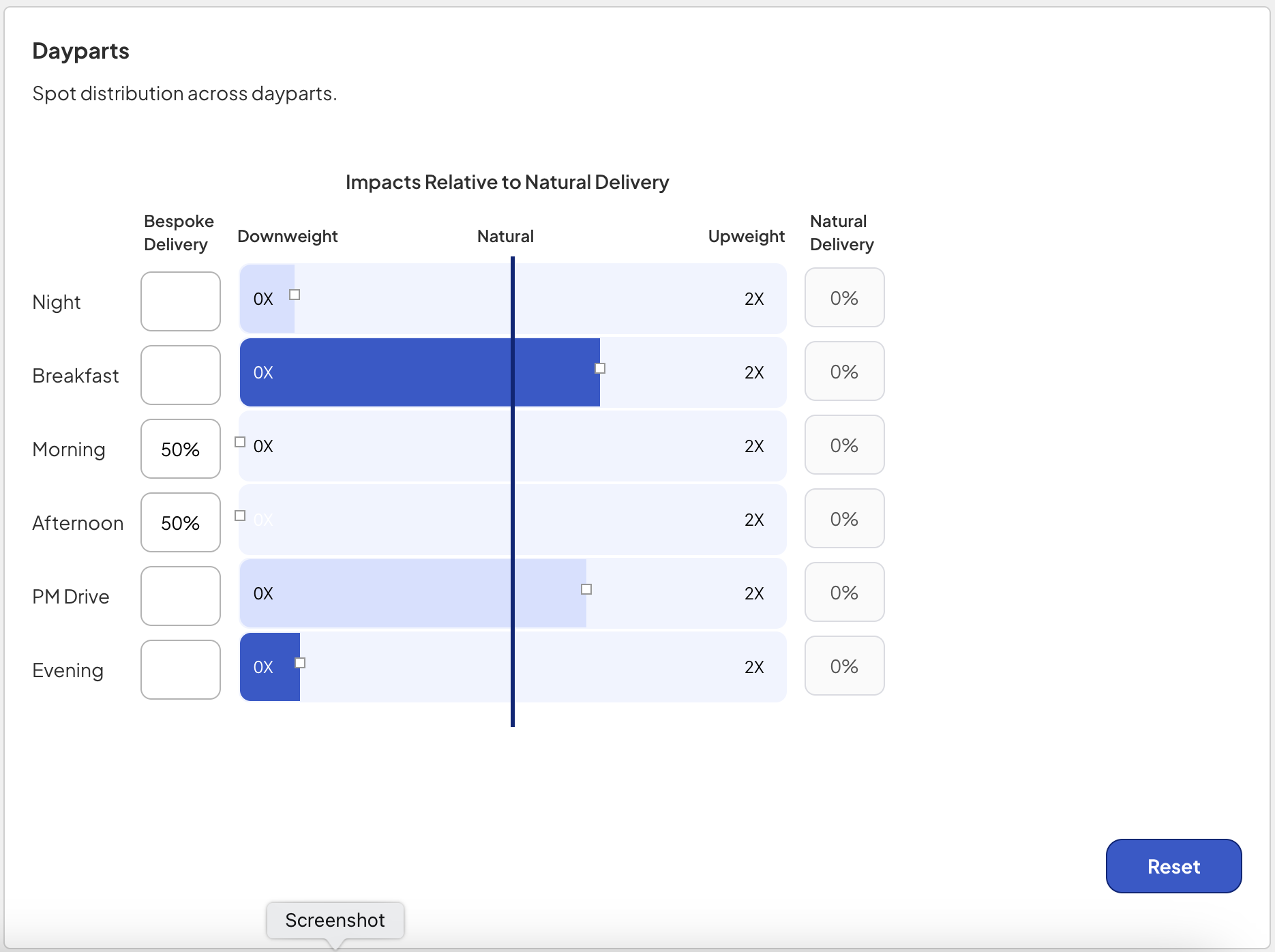
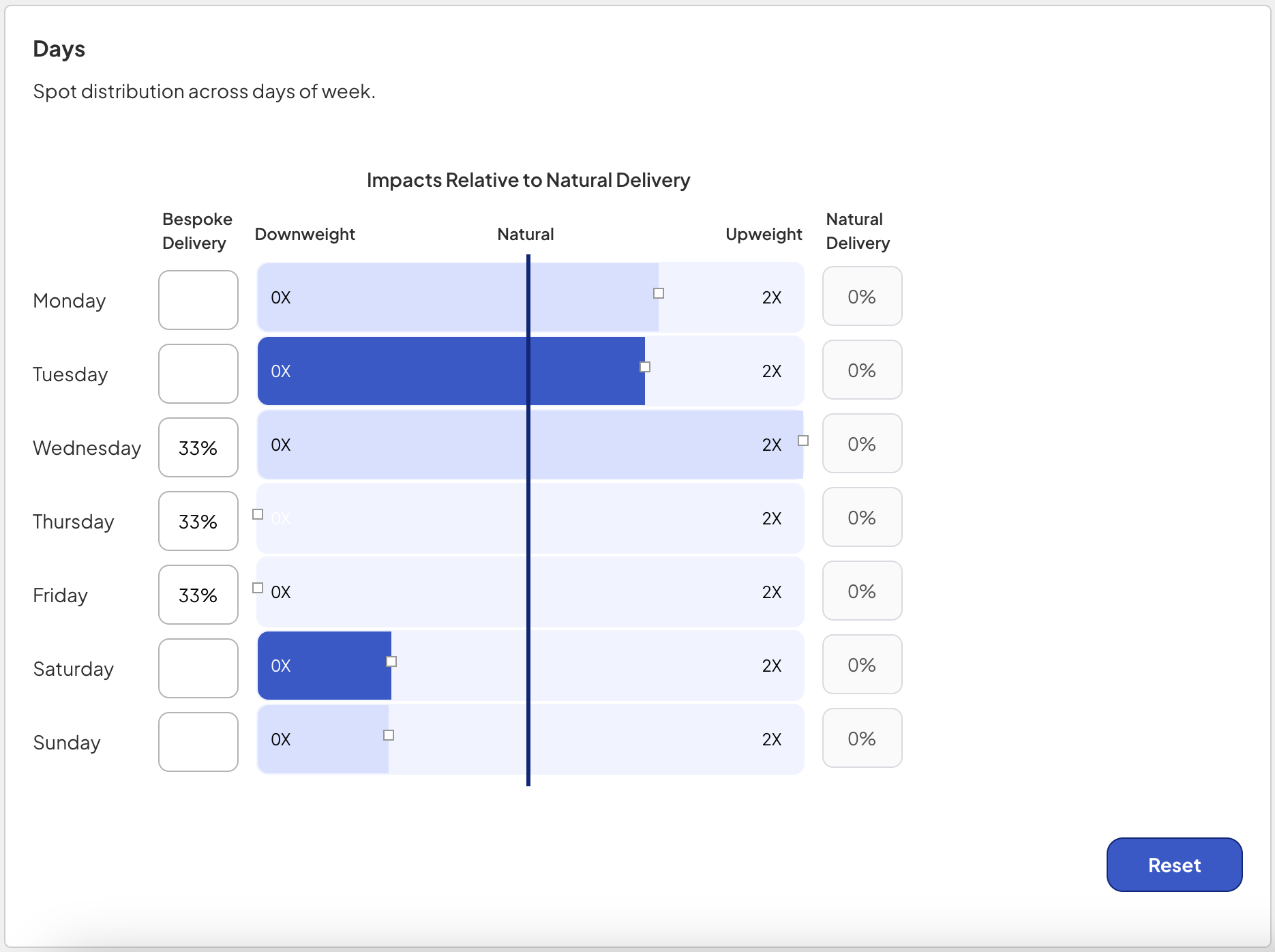
Real briefs don't follow natural delivery — Drive-heavy, light Breakfast, under-indexed Tuesdays.
- Up- or down-weight delivery by daypart and day of week against natural
- Or pin bespoke percentages where the brief is specific
- Pulse re-solves instantly against the same goal, inventory and audience
Campaign Quote
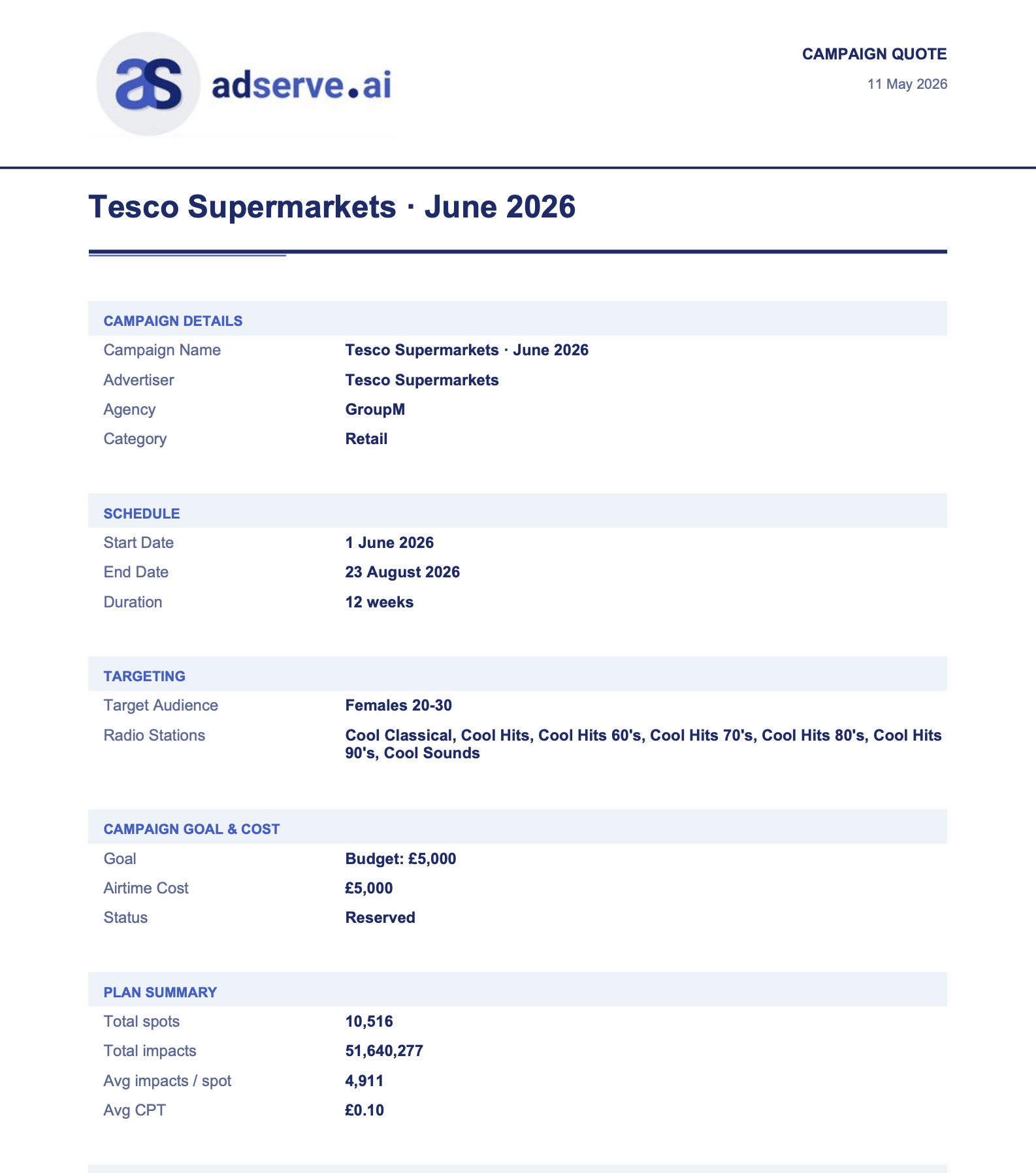
The advertiser's quote is the same plan held in the system — not a PDF rebuilt by hand.
- One click: a branded, advertiser-ready proposal — schedule, targeting, goal, spots, impacts, CPT
- Approve it and the plan becomes a confirmed booking, straight into Pulse
- No re-keying, no version drift, no "is this the version we agreed?"
Transmission Times with AI
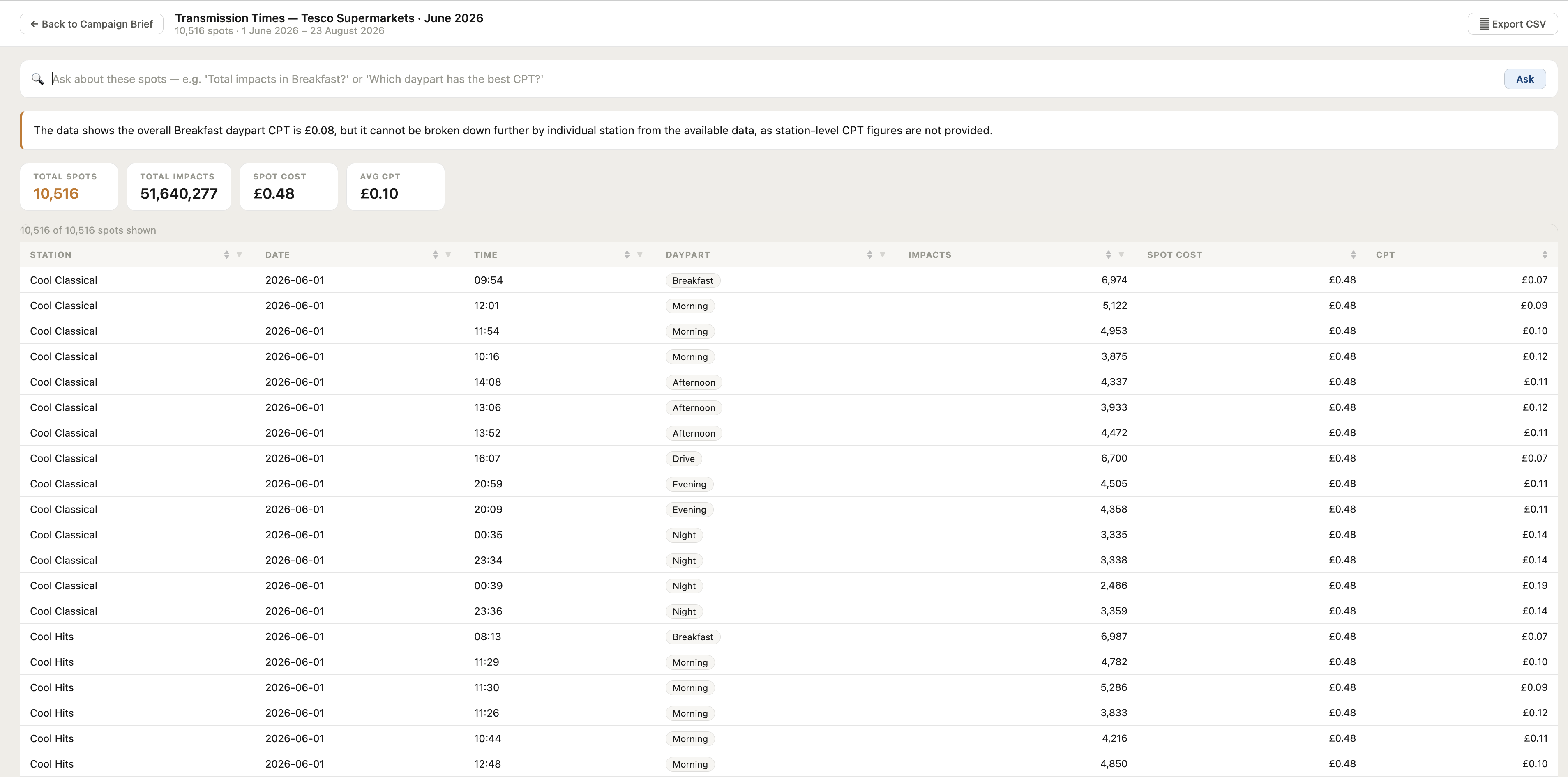
Every spot at row level — date, time, station, daypart, impacts, cost, CPT — with an AI assistant on top.
- Ask in plain English: "Which daypart delivers the best CPT?" "Why are afternoon impacts low?"
- Reweight Drive and see the result — no BI tool, no analyst, no CSV export
- AI-native in practice: interact the way you think, not how the database is built
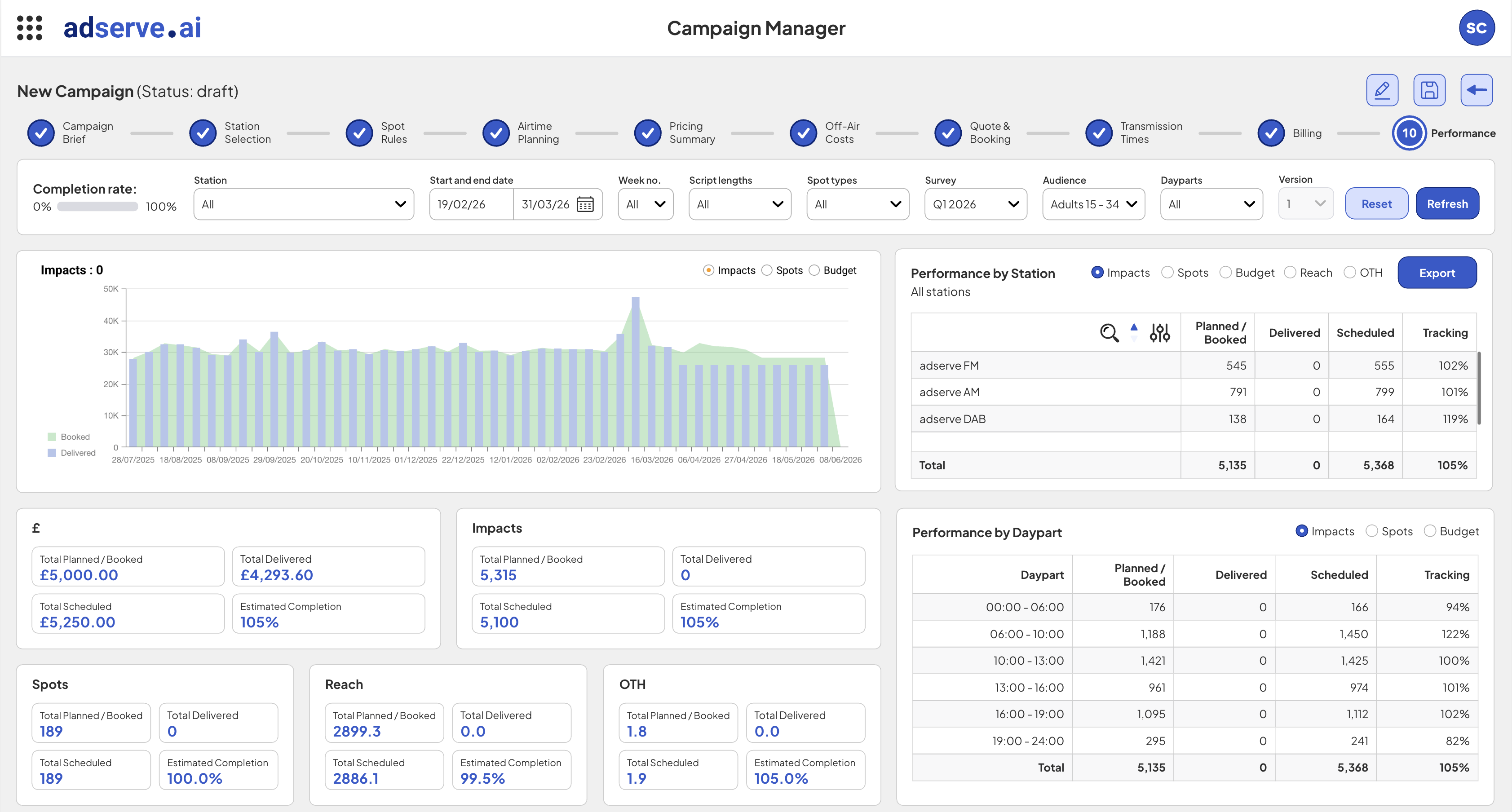
Campaign performance reporting
Post-campaign analysis used to take weeks of pulling logs and rebuilding the plan in Excel.
- The PCA runs live, against the original plan, from the same dataset that placed the spots
- Impacts, spots, reach, OTH, spend and completion — by station and daypart — updating as it runs
- Shifts the advertiser conversation from "last month" to "right now, and what's next"
See the journey with your own inventory
Book a walkthrough and we'll show you CRM to invoice, end to end.
One journey, every channel.
The same commercial workflow that powers broadcast radio extends seamlessly to every other channel. One proposal, one plan, one invoice — whether the campaign runs on linear audio, digital audio, video, social or online.
Broadcast radio
Linear AM/FM/DAB radio with full break management, audience-led selling and Pulse scheduling.
Digital audio
Streaming, podcast and on-demand audio via Triton and other digital ad servers.
Video & CTV
Linear and connected TV inventory bookable alongside audio in the same campaign brief.
Social & online
Display, social and search inventory connected via Google Ad Manager, TikTok Ads and YouTube.
Connected to the platform.
Order Management System is one of four capability areas in adserve Studio. Data flows downstream automatically.
Pulse — Optimisation engine
Confirmed bookings flow directly into Pulse for scheduling, optimisation and delivery tracking. Reconciled airplay data flows back into Billing.
Explore Pulse DownstreamTrafficking & broadcast ops
Plans become live broadcasts. Trafficking picks up from Order Management System to manage logs, breaks and playout integration.
Explore Trafficking ConnectedCopy & creative management
Briefs captured in Campaign Manager become the input to AI copy generation — closing the gap between commercial intent and broadcast-ready audio.
Explore Copy & CreativeReady to connect your commercial journey?
From first lead to final invoice — one platform, one record, one workflow. Get in touch to arrange a demo.