Pulse
The hosted, API-driven optimisation and scheduling engine at the heart of adserve.
Every digital channel has an ad server. Linear radio never had one — until Pulse. A purpose-built broadcast optimisation engine that intelligently manages inventory, places ads programmatically, traffics campaigns to air and automatically reconciles every spot against what was sold. With fully documented REST APIs, both adserve Studio modules and third-party systems connect for planning, optimisation and scheduling.
The same programmatic precision your digital channels enjoy — now for linear.
Every digital channel has had an ad server for two decades. Linear radio never had one — schedules were assembled by people, in spreadsheets, against rate cards that hadn't moved in months. Pulse closes that gap. It is the hosted, AI-driven optimisation and scheduling engine that broadcast radio has been missing — and the foundation that turns a station group's commercial operation into something that finally runs at the cadence of the market it sells into.
Real-time inventory management
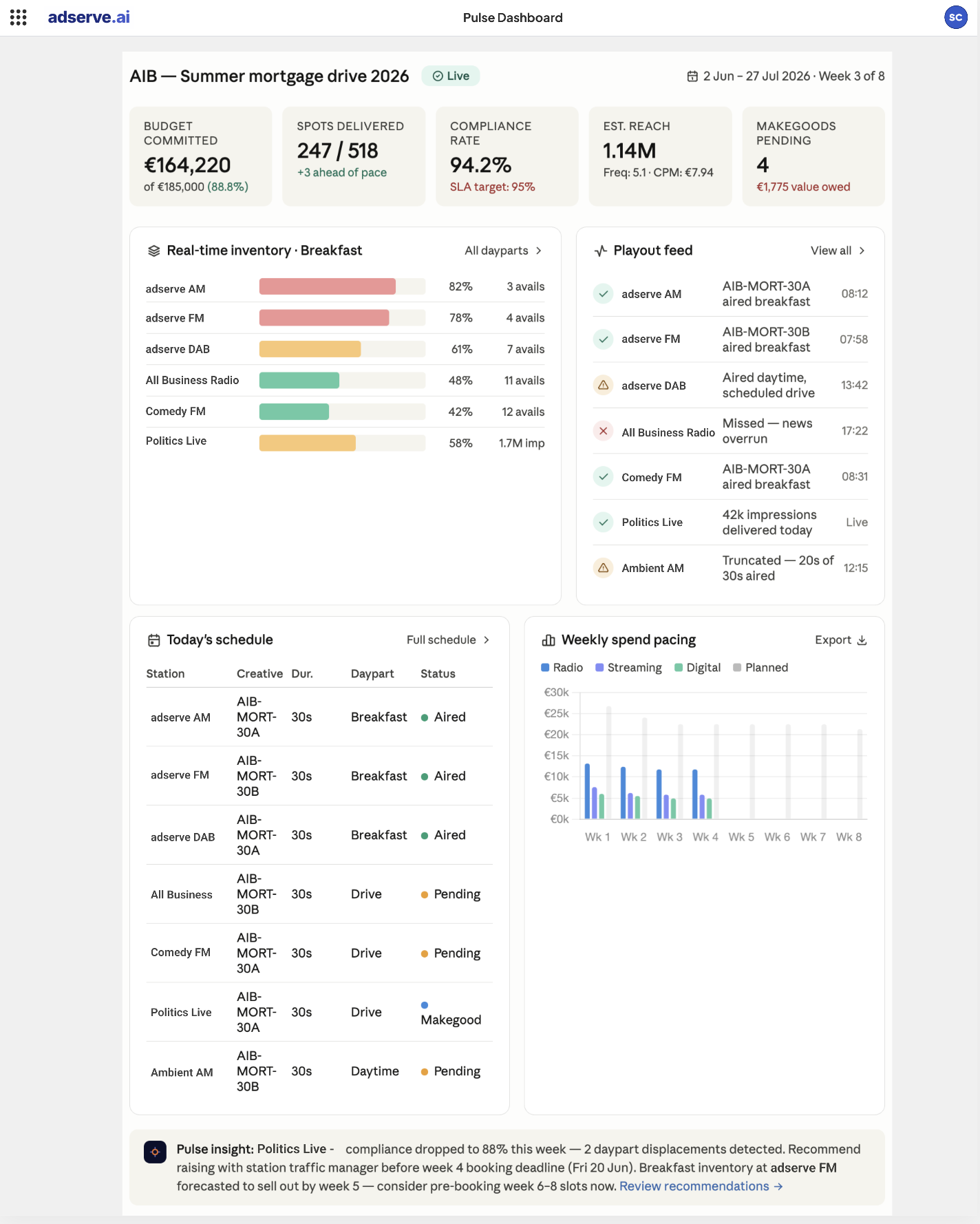
For most broadcasters, "what's available?" is still a question that takes hours to answer accurately — because availability lives in a traffic system that's a day behind sales, and sales lives in a CRM that doesn't know what's been confirmed. Pulse holds a single, live model of every spot in the schedule. The moment a booking is confirmed, modified or pulled, availability across stations, dayparts and break positions updates everywhere at once.
Sales reps see a true picture of what they can sell. Planners stop double-booking. Revenue teams stop discovering leakage at month-end. The same live state powers every downstream module and every external system connected via API.
Intelligent spot placement
Pulse doesn't just record where spots go — it decides. AI-driven placement balances audience delivery targets, advertiser priorities, category clashes and yield in a single optimisation pass, returning a fully allocated plan in seconds rather than the days it takes a planning team working by hand.
The engine is built for the operational reality of broadcast: deterministic scheduling, fixed break structures, makegood logic, regulatory rules — the constraints that digital-first ad servers simply don't model. That's why placement decisions land in playout-ready form, not as recommendations a human has to translate.
Automated trafficking to air
Plans don't stop at the planner's screen. Pulse pushes them directly into RCS, GTN, Myriad and other playout systems via dedicated connectors — building logs automatically, propagating schedule changes within seconds, and removing the manual handoff that has historically slowed every station group down between sales and air.
Last-minute campaign changes that used to require a phone call and a re-cut log now happen as data flowing between systems. The traffic team's day shifts from re-keying to managing exceptions — the work that actually requires human judgement.
Full-loop reconciliation
Every spot Pulse places is matched back against the playout log it actually aired on. Only confirmed broadcasts trigger billing — closing one of the biggest revenue-leakage gaps in commercial radio, where unverified airplay or unpicked-up makegoods quietly erode margin every month.
It also gives the finance team something most broadcasters have never had: a real-time, spot-level audit trail from sold to aired to invoiced, drawn from one dataset rather than reconciled across three. SOX, internal audit and advertiser disputes all become easier in the same stroke.
Autonomous exception management
When a campaign is pulled, inventory tightens, or a delivery guarantee falls behind, Pulse doesn't wait for someone to notice. AI agents monitor delivery against commitments around the clock and act — replacing dropped spots with paid alternatives (not fillers), proposing makegoods within the same client's existing contract, and flagging only the cases that genuinely require a human call.
The economic effect is direct: revenue that previously slipped through the cracks every month, because the team noticed too late to recover it, stays in the schedule and on the invoice.
Predictive yield optimisation
Static rate cards in a dynamic market is the structural problem behind most under-monetised broadcast inventory. Pulse continuously models demand against available supply — by station, daypart, audience and lead time — and flexes pricing within the rules the commercial team sets. Where demand is high, rates tighten; where inventory risks going unsold, prices ease to clear it.
The result is the yield curve every digital channel takes for granted, applied for the first time to linear: more revenue from the same hours, without the spreadsheet warfare.
Built for broadcast. Built to be opened up.
Pulse is not a feature inside a closed suite — it is the optimisation engine, exposed as a hosted API, designed to be consumed by adserve Studio modules and third-party systems on identical terms.
Decisions, not just dashboards.
The engine is built around autonomous agents that plan, place, reconcile and recover — not analytics layered on top of a manual workflow. Every action Pulse takes is auditable, explainable and bounded by the commercial rules you set. The team's job becomes governing the system, not running it.
Hosted, documented, externally consumable.
Pulse's REST APIs are versioned, openly documented and accessible to any system you connect — every planning, optimisation, scheduling and reconciliation capability the platform offers is reachable from the same APIs the adserve Studio interface uses. Whether you run adserve Studio end-to-end or plug Pulse into a stack you already own, the integration story is identical.
Linear isn't a digital channel with longer ads.
Deterministic break placement, makegood logic, category clash rules, rate card depth, audience-led pricing — the things that make broadcast radio different from programmatic display are first-class concerns in Pulse's data model, not afterthoughts bolted onto a digital ad server.
Connects to everything that matters.
Playout systems
RCS, GTN, Myriad and other major playout systems via dedicated connectors and the Scheduling API.
Digital ad servers
Google Ad Manager, TikTok Ads, YouTube and other digital platforms — for blended omni-channel delivery.
Audience measurement
RAJAR, JNLR, Ipsos and other measurement systems — feeding planning and pricing decisions in real time.
Business systems
Salesforce, Microsoft Dynamics, SAP, QuickBooks, HubSpot — connecting Pulse to the wider commercial stack.
From 4 employees to 5,000 stations.
Connected to every capability.
Pulse is the engine the rest of adserve Studio runs on. Bookings flow in from Order Management System, scheduled spots flow out to Trafficking, and verified delivery flows on to Reporting & Analysis — all over the same documented APIs available to any third-party system.
Order Management System
Confirmed bookings, briefs and inventory holds enter Pulse via the Planning and Inventory APIs — the same surface every commercial team and third-party CRM uses.
Explore Order Management System DownstreamTrafficking & broadcast ops
Pulse pushes scheduled spots straight into the connected playout system — RCS, GTN, Myriad or another — building logs and propagating changes within seconds.
Explore Trafficking DownstreamReporting & analysis
Reconciled spot-level delivery feeds Reporting & Analysis in real time — the same dataset that drives billing, yield modelling and advertiser dashboards.
Explore Reporting & AnalysisReady to see Pulse in action?
Get in touch to arrange a demo and see how Pulse can become the optimisation engine at the heart of your media operation.