
The latest RAJAR figures tell a rather encouraging story about the state of British radio. At a time when audiences have more entertainment choices than ever, when almost every screen competes for attention and when the audio landscape continues to evolve at extraordinary speed, radio has achieved something remarkable.
More people are listening to radio than ever before.
The Q3 2026 results reveal a record 51.2 million weekly radio listeners across the UK, an increase of approximately 2% year-on-year. Commercial radio, meanwhile, reaches almost 40 million people every week, maintaining a substantial lead over the BBC.
For an industry that has spent years hearing predictions about its eventual demise, the numbers make for rather satisfying reading.
Perhaps the most significant development, however, lies beneath the headline audience figures. Radio's digital transformation is accelerating, commercial broadcasters are demonstrating their ability to attract audiences across multiple platforms, and the opportunities for advertisers are becoming increasingly sophisticated.
The message from RAJAR is clear: radio remains extraordinarily relevant, and the commercial sector has plenty of reasons to be optimistic.
Commercial radio continues to lead the market
Commercial radio's position as the UK's most widely consumed radio sector remains impressive.
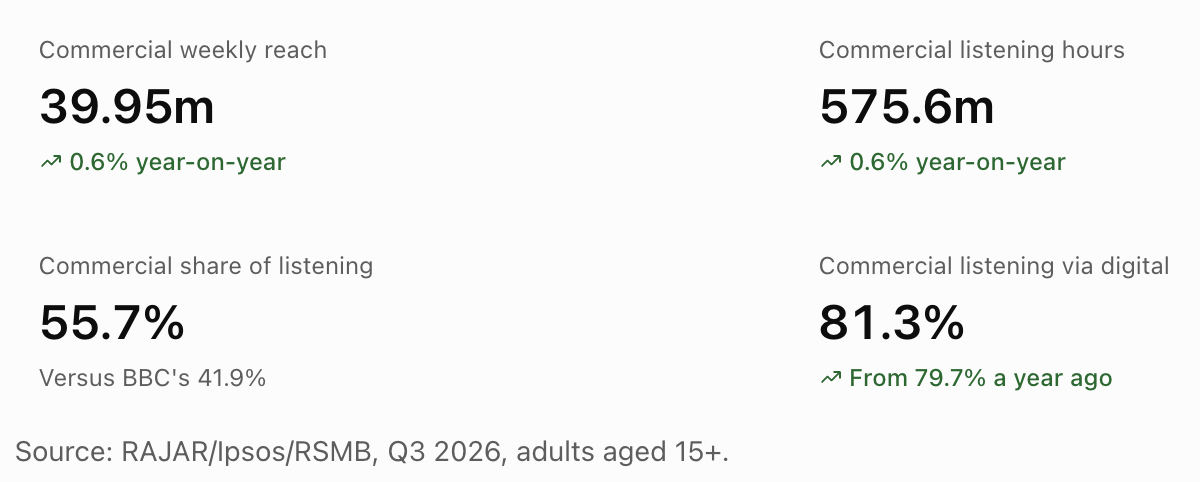
According to RAJAR, commercial stations collectively attract 39.95 million weekly listeners, compared with 31.02 million for BBC radio. That's a difference of almost nine million people.
Commercial radio also commands 55.7% of all radio listening hours, against the BBC's 41.9%. Its audience generates approximately 576 million listening hours every week, an extraordinary volume of engagement in an increasingly fragmented media environment.
Even more encouragingly, commercial radio's weekly reach and total listening hours have both grown year-on-year.
There are some nuances. Commercial radio's listening share is marginally below the 56% recorded a year earlier, and its weekly reach has softened slightly from Q2. But the broader picture remains healthy: an audience approaching 40 million, growing consumption, and a clear lead over the BBC in both reach and listening share.
For advertisers, that combination of scale and sustained engagement is enormously valuable. Radio remains one of the few advertising media capable of reaching large audiences repeatedly throughout their everyday routines.
Digital radio is now the mainstream
Perhaps the most compelling story emerging from this release is how thoroughly digital listening has become embedded in British life.
Across all radio, 76.4% of listening hours are now delivered through digital platforms, including DAB, websites, apps, smart speakers and digital television.
Commercial radio is considerably further ahead, with digital accounting for an impressive 81.3% of its total listening.
That means fewer than one in five commercial radio listening hours now take place through traditional AM/FM.

DAB remains the largest platform, representing 45.2% of commercial listening hours, up from 44.4% a year earlier.
Meanwhile, online listening has reached a new record of 34.1%, compared with 33.5% in Q3 2025.
This is particularly interesting because it demonstrates that digital radio growth is happening across different types of technology. DAB remains enormously successful, while internet-connected devices are creating entirely new ways for audiences to discover and consume radio.
The industry's digital future is no longer a distant ambition. It is already delivering the overwhelming majority of commercial listening.
Smart speakers are becoming radio's new household companion
One of the most fascinating developments is the growing importance of smart speakers.
These devices now account for 18.7% of all UK radio listening hours, representing approximately 193 million hours each week. For commercial radio specifically, their contribution is even greater, at 22.2%.
That means more than one in five hours spent listening to commercial radio now takes place through a smart speaker.
The significance extends beyond the technology itself. Smart speakers have brought radio into kitchens, bedrooms and living rooms in an entirely new way, allowing audiences to access favourite stations through a simple voice command.
And the behaviour is proving remarkably durable. Commercial smart-speaker listening share has remained at approximately 22% for the past year.
For broadcasters, this represents an opportunity to develop stronger relationships with audiences in the home. For advertisers, it creates possibilities for better understanding listening environments and, where supported, delivering more relevant advertising experiences.
The younger audience story deserves more attention
One particularly encouraging statistic concerns younger listeners.
Commercial radio reaches 18.6 million people aged 15–44 each week, equivalent to 67% of that population.
More impressively, commercial broadcasters account for 67% of all radio listening hours within this age group, compared with the BBC's 29.3%.

It is a powerful reminder that commercial radio remains relevant to generations whose media habits are often assumed to be dominated by streaming services and social platforms.
There is a qualification: listening hours among commercial radio's 15–44 audience declined by approximately 4% year-on-year. Maintaining engagement with younger listeners remains an important challenge.
Nevertheless, commercial radio's commanding share of listening within this demographic provides a strong platform for future growth.
Big brands, specialist stations and some impressive winners
The latest results also contain plenty of individual success stories.
Global's Heart remains the UK's largest commercial radio brand, reaching 13 million weekly listeners, ahead of BBC Radio 2's 12.7 million. Capital reaches 9.1 million, while Smooth attracts 7.5 million.
LBC's audience has grown 6.8% year-on-year to approximately 3.6 million, demonstrating the continued appetite for commercial speech radio.
At Bauer, the rejuvenated KISS Network has grown 12% year-on-year to 3.9 million listeners, while Planet Rock has increased its audience by almost 8% to 1.2 million. Kerrang! Radio has also enjoyed double-digit growth.
News UK's talkSPORT has benefited from a major summer of sport, with reach increasing almost 9% year-on-year. talkSPORT 2 has grown by an even more impressive 22.5%.
Beyond the established networks, specialist services are finding enthusiastic audiences. Classic FM Calm now reaches 465,000 listeners, Smooth Country 509,000, and Greatest Hits Radio 80s has attracted 644,000.
These successes illustrate an important characteristic of modern commercial radio: audiences increasingly value services tailored to their individual tastes.
The industry can serve millions through established national brands while simultaneously building meaningful audiences around particular genres, decades, interests and lifestyles.
That diversity is becoming an increasingly valuable commercial asset.
Local radio still has an important role
National commercial radio continues to gain ground, with listening hours increasing approximately 4% year-on-year to 308 million.
Local commercial radio, meanwhile, reaches 25.7 million listeners each week and generates 268 million listening hours.
Although local commercial reach and hours have declined compared with last year, its continuing scale remains impressive.
The opportunity lies in combining the efficiency and sophistication of national broadcasting with the community relationships, local knowledge and regional relevance that have always distinguished radio.
For smaller businesses in particular, the ability to advertise within a recognisable local environment remains an attractive proposition.
The challenge for broadcasters is to preserve that local relevance while embracing the efficiencies and technological opportunities of an increasingly digital industry
Why advertisers should be paying attention
Radiocentre's response to the figures is understandably enthusiastic.
Its CEO, Matt Payton, emphasised radio's extraordinary reach, growing commercial listening hours and ability to combine audience scale with advertising targeting.
That last point is particularly significant.
As more radio listening moves onto connected platforms, broadcasters have opportunities to complement traditional broadcast campaigns with more sophisticated digital advertising capabilities.
Audience segmentation, geographic targeting, improved campaign measurement and dynamic creative all offer possibilities for making radio advertising more effective and accountable.
The opportunity is to connect radio's established strengths, trusted environments, familiar personalities and habitual listening, with the capabilities advertisers increasingly expect from digital media.
And because broadcast and digital listening coexist, advertisers can potentially benefit from both broad-reach campaigns and more precisely targeted activity.
RAJAR measures audiences rather than advertising effectiveness, so these developments are opportunities rather than outcomes established by this release. Nevertheless, the direction is encouraging.
An industry with plenty to look forward to
Perhaps the most encouraging conclusion from Q3 2026 is that radio continues to demonstrate an extraordinary capacity to evolve.
A medium with more than a century of history is attracting record audiences, adapting successfully to connected devices and developing new services that reflect increasingly diverse listener preferences.
Commercial radio now reaches almost 40 million people every week. It commands the majority of UK radio listening, dominates listening among younger adults and generates more than half a billion listening hours every seven days.
These are substantial achievements.
There will inevitably be challenges. Audience competition remains intense, some established stations face pressure, and changing listening habits require constant investment and innovation.
But the underlying foundations of commercial radio remain remarkably strong.
For broadcasters, technology providers, agencies and advertisers, the opportunity is to build upon a medium that continues to demonstrate both resilience and relevance.
The latest RAJAR results suggest that commercial radio's next chapter could be every bit as exciting as its last.
And with nearly 40 million people tuning in every week, there are plenty of people listening to see what happens next.
Disclaimer: This article reflects the independent analysis, views and opinions of adserve, based on publicly available RAJAR audience data and industry commentary. The interpretations and conclusions expressed are entirely our own and should not be taken to represent the views, opinions or endorsements of RAJAR, Radiocentre, individual broadcasters, radio stations or the wider radio industry. While every effort has been made to ensure accuracy, readers are encouraged to refer to the official RAJAR publications for definitive audience figures.
Was this useful?